

The gallbladder is situated in the right upper part of the abdomen. It stores bile, manufactured in the liver, until a meal is taken. Some people develop gallstones in the gallbladder although the reason is not entirely clear. Gallstones cause pain, inflammation of the gallbladder, pancreatitis or jaundice. Once symptoms appear they usually continue to occur. Although other treatments have been tried, removing the gallbladder is the only satisfactory method.
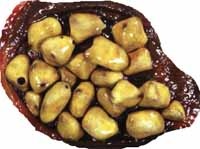
Cholecystectomy is the operation to remove the gallbladder. It is designed to treat the pain or to prevent further attacks of jaundice or pancreatitis. Bloating, belching wind, heartburn and bowel symptoms are not due to gallstones and are not made better by the operation. It is necessary to remove the gallbladder rather than just the stones. If only the stones were removed and the gallbladder left inside more stones would form. In general no changes to the body’s functions take place and there do not appear to be any long-term adverse side effects.
The operation is carried out under general anaesthetic using a laparoscopic or keyhole technique. Small puncture holes, usually four, are made in the abdominal wall to insert a telescope and a variety of operating instruments. The gallbladder is identified and the artery supplying it and the duct tube leaving it are identified, clipped and divided. The gallbladder is removed through one of the puncture wounds. Small stitches are inserted in the skin but these are usually dissolvable. There is often a little swelling around the wound sites for a couple of weeks and sometimes some bruising.
Most people (over 90%) are able to eat and drink and leave hospital within 2 hours. Recovery thereafter takes only a few days and most people can be back to normal, including work and gentle sporting activities, in 7 to 10 days. No special care is required after the operation. Driving can be resumed after a few days if all is well. No special medical attention is required after leaving the hospital.
After the operation there need to be no special restrictions in respect of diet. Fats can be eaten but it is possible to overdo this and put on weight. There may be some persistent bumpiness and bruising around the wounds. This is not a matter for concern and will improve.
In some cases there are stones in the bile duct. This is the tube leading from the liver to the bowel and the gallbladder is off the side of this tube. These stones will need to be removed either by a telescope method before or after the gallbladder operation or at the time of the gallbladder operation.
All operations are associated with risks and the gallbladder operation is no exception. However, it usually goes smoothly but complications arise in about 5% of cases. They are usually mild and easily resolved. The most serious complication is an injury to the bile duct and this occurs in about 0.5% of cases. It may be recognised at the time of the operation and repaired or it may need corrective surgery later. In about 5% of cases it is necessary to change from a keyhole to an open operation because of some difficulty. This is usually very severe inflammation around the gallbladder making the risk of injury to the bile duct and other structures more likely. Occasionally there is some bleeding, which cannot be adequately controlled using the keyhole technique. Blood transfusion is very rarely required. The gallbladder will usually be sent to the pathology laboratory for examination.
Photographic or video recordings are sometimes made of operations for educational purposes. These carry no identification marks.
